
KEY TAKEAWAYS
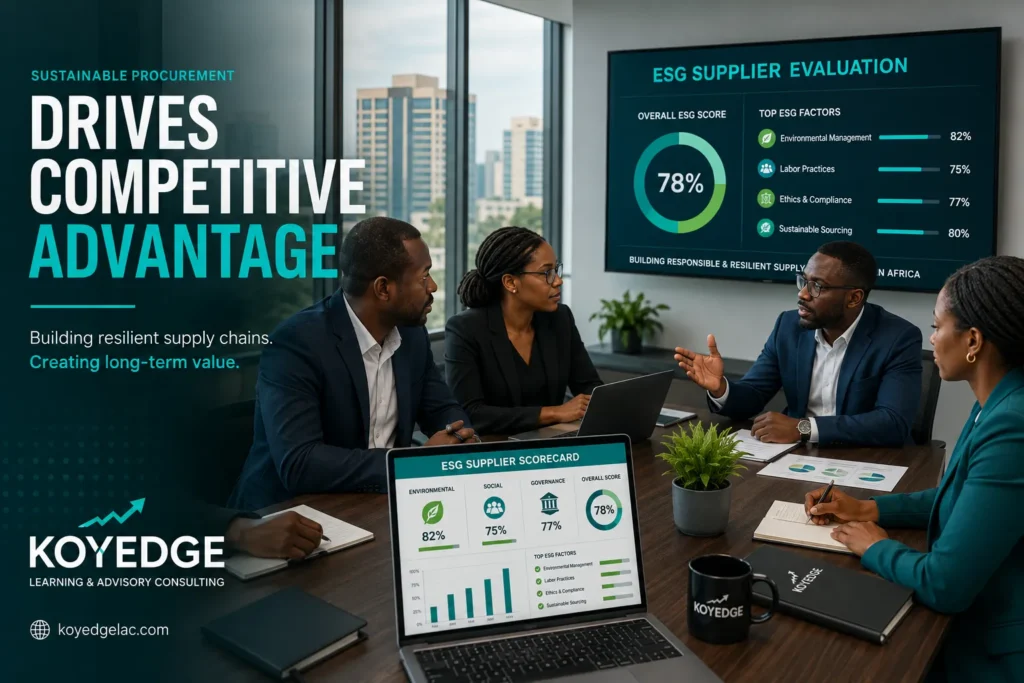
- Sustainable procurement is no longer a donor-driven checkbox , it is a direct lever for cost reduction, supplier reliability, and contract competitiveness.
- Organisations that embed ESG criteria into supplier selection consistently outperform those that treat sustainability as a reporting task.
- In Ghana and across West Africa, procurement sustainability is increasingly tied to public tender eligibility , the market is moving faster than most procurement teams realise.
- You do not need a full ESG framework on day one. A tiered approach , starting with supplier registration and basic environmental screening , is both practical and defensible.
- The organisations that lead on sustainable procurement are training their procurement teams to use it as a strategic tool, not just a compliance form.
The Shift Most Procurement Teams Have Not Fully Processed
Here is something we hear regularly in procurement advisory engagements across Ghana and West Africa: ‘We do sustainable procurement , we have a policy.’ Then we ask to see the supplier registration form, the evaluation scorecard, the contract clauses, and the performance review template. In most cases, the policy exists. The practice does not.
Sustainable procurement , the process of embedding environmental, social, and governance criteria into every purchasing decision , has moved from a donor compliance requirement into a genuine source of competitive advantage. Organisations that understand this shift are winning contracts, retaining better suppliers, and managing risk far more effectively than those that have not made the transition.
In our advisory work with public sector bodies, development organisations, and corporates across West Africa, we have watched this shift happen in real time. The organisations that treated sustainability as a reporting exercise are now scrambling to catch up. The organisations that embedded it into their procurement systems early are reaping the benefits , in supplier performance, in tender eligibility, and in institutional credibility.
This article sets out why that shift has happened, what it looks like in practice, and what procurement managers and organisational leaders need to do right now to build a sustainable procurement function that actually creates value.
What is Sustainable Procurement?
Sustainable procurement is the process of integrating environmental, social, and governance (ESG) criteria into purchasing decisions , from supplier selection through to contract management and performance review. It goes beyond buying ‘green’ products.
It means choosing suppliers who meet defined standards on labour practices, environmental impact, and ethical governance, and holding them to those standards through the life of the contract. (CIPS, 2023)
Why Sustainable Procurement Is Now a Competitive Advantage in Ghana and West Africa
The short answer: procurement decisions now have reputational, regulatory, and financial consequences that go far beyond the purchase order. Organisations in Ghana and across West Africa are increasingly evaluated , by donors, by development partners, and by international buyers , on the environmental and social quality of their supply chains. Sustainable procurement is no longer a background activity. It is front-of-house.
Most people will tell you that procurement is about getting the right goods and services at the right price. In our experience working across the region, that framing misses the point entirely. Price matters. But right now, in 2025, the organisations winning the most competitive contracts are winning because of how they source , not just what they pay.
The Ghana Public Procurement Authority has progressively tightened its compliance requirements, and international development partners including the World Bank, USAID, and the European Union have embedded ESG screening criteria into procurement evaluation processes for grant-funded programmes.
In practice, this means that Ghanaian and West African organisations bidding for institutional contracts are increasingly being assessed on supplier documentation, environmental policies, and social safeguarding practices , not just technical competence and price.
The Chartered Institute of Procurement and Supply (CIPS, 2023) reports that 72% of procurement leaders globally now cite sustainability as a top-three strategic priority. More importantly , and this is often missed , that priority is no longer being driven from the top by CSR departments. It is being driven from the bottom up by buyers, donors, and contract award criteria. (CIPS, Sustainability in Procurement Report, 2023)
We worked with a mid-sized NGO in Accra last year that had just lost a significant donor-funded contract to a competitor with a less experienced team but a cleaner, better-documented procurement system , including an ESG supplier register and an environmental screening checklist. The evaluation panel awarded sustainability compliance a 20% weighting. Our client had not scored those points. The lesson was direct and expensive.
The real question is not ‘does our organisation care about sustainability?’ Most organisations do, at least in principle. The real question is: ‘Do our procurement systems make that care visible and verifiable to external evaluators?’ For most organisations across the region, the honest answer right now is no. That is the gap sustainable procurement closes.
How to Integrate ESG Criteria into Your Sustainable Procurement Process
Integrating ESG into procurement does not mean redesigning everything at once. It means adding structured criteria , environmental screening, social safeguards, and governance checks , to your existing supplier registration, evaluation, and contract management processes. Done in the right sequence, this is achievable within 90 days for most organisations.
The most common mistake we see is organisations trying to implement a full ESG framework before they have a stable procurement system underneath it. Sustainability criteria applied to a broken procurement process produce worse outcomes , more confusion, more inconsistency, and more compliance exposure , not less.
What consistently works in this context is a tiered approach. In an advisory engagement with a public sector agency in the Greater Accra Region, we used the following three-stage model to integrate ESG into their supplier qualification process without disrupting active contracts:
Stage 1: ESG Supplier Registration Criteria
Add five core ESG questions to your supplier registration form. At minimum, ask about: environmental management practices, labour and employment compliance (including sub-contracting), social safeguarding policies, anti-corruption and gifts policies, and business continuity documentation. These are threshold questions. They signal to suppliers that your organisation is serious about standards and give you a documented basis for disqualification if a supplier misrepresents their position.
Stage 2: ESG Evaluation Weighting in Tender Scoring
Build a specific ESG weighting into your evaluation scorecard , we typically recommend between 10% and 25% depending on the sector, contract value, and donor requirements. For development organisation procurement, 20% is increasingly the standard applied by multilateral partners. Score against defined criteria, document the rationale, and train your evaluation panel members. A weighted scorecard that no one knows how to apply is not a control , it is a paper exercise.
Stage 3: ESG Contract Clauses and Performance Monitoring
Include ESG performance clauses in contracts , particularly for high-value or long-term engagements. These should set out what suppliers are expected to do (maintain environmental policies, comply with labour laws, allow periodic audits) and what happens if they do not. Then monitor. Four out of six public sector clients we supported in 2024 had ESG clauses in their contracts but had never conducted a supplier ESG review. The clause without the monitoring is decorative.
The OECD’s Due Diligence Guidance for Responsible Business Conduct (OECD, 2018) provides a strong international reference point for structuring this kind of tiered approach, and its principles translate well into the West African institutional context. OECD Due Diligence Guidance ,
The Business Case for Sustainable Procurement: What the Data Shows
The commercial case for sustainable procurement is no longer theoretical. Organisations with structured ESG supplier management consistently report lower dispute rates, stronger contract performance, and measurable reductions in procurement risk. Here is what the evidence shows , and what we have seen directly in engagements across the region.
We have seen this pattern consistently across procurement engagements in West Africa: organisations that chase lowest price pay more in the long run. A supplier with no environmental management practice will cut corners on materials. A supplier with no labour compliance record will have high turnover and delivery inconsistency.
A supplier with no anti-corruption policy is a liability in any regulated or donor-funded environment. The cost of those failures , disputes, rework, reputational damage, contract penalties , almost always exceeds the savings made at the tender stage.
The numbers support this. Research by the World Bank (World Bank, Procurement in Development Projects, 2022) found that development organisations with structured supplier performance management frameworks reduced contract disputes by an average of 34% compared to those relying on informal or ad hoc oversight.
More significantly, those organisations reported 28% faster delivery completion on programme contracts , which in development work translates directly into outcomes for the communities being served.
In the private sector across Ghana, we are also seeing procurement sustainability linked directly to export and partnership eligibility. Ghanaian companies exporting to European buyers , particularly in agriculture, cocoa, and manufacturing , are now required to demonstrate supply chain due diligence compliance under the EU Corporate Sustainability Due Diligence Directive (EU CSDDD), which entered into force in 2024.
Organisations without ESG-aligned procurement documentation are being removed from supplier lists. This is not a distant European problem. It is an immediate commercial reality for Ghanaian exporters right now.
The Rainforest Alliance , which operates certification programmes across West Africa’s agricultural supply chains , has documented a 15–20% price premium for certified sustainable produce in international markets. (Rainforest Alliance, Sustainable Agriculture Standards, 2022).
That premium is only accessible to organisations whose internal procurement and sourcing practices can be evidenced and verified. Certification without documentation is not certification , it is a claim.
Building the Team: Why Sustainable Procurement Requires Procurement Professionals, Not Just Sustainability Champions
Sustainable procurement fails most often not because of missing policies , but because the procurement team has not been equipped to apply ESG criteria with the same rigour they apply to price, quality, and lead time. This is a capability problem, and it is solvable through deliberate, applied training , not just awareness sessions.
If you have run a sustainability training programme for your procurement team and watched it produce no lasting change in how they evaluate suppliers or manage contracts, we understand the frustration.
That is exactly why KOYEDGE’s capacity-building approach to sustainable procurement is built around behaviour change and applied tools , not just concept delivery.
The gap we see most frequently is this: procurement professionals know the language of sustainability.
They can talk about ESG, carbon footprints, and social safeguards. What they struggle with is how to operationalise those concepts inside a live procurement process , how to write a defensible ESG evaluation criterion, how to score a supplier’s environmental policy against a defined standard, how to raise a supplier performance concern in writing without creating a legal exposure.
Gartner’s Procurement Research (Gartner, 2024) found that only 22% of procurement professionals feel confident in their ability to assess supplier ESG compliance.
That confidence gap is not a personal failure , it is a training and system design failure. The right response is not to hire an ESG specialist and park them separately from the procurement function.
The right response is to train your procurement team to own ESG as part of their core role.
In practice, this means procurement managers need to understand: how to write ESG criteria into tender documents, how to run a supplier ESG audit (even a basic desktop review), how to interpret an environmental management statement, and how to manage a supplier conversation about non-compliance without escalating unnecessarily.
These are learnable skills. We deliver them as part of KOYEDGE’s Sustainable Procurement training programme, which is designed specifically for procurement professionals working in the African organisational context.
Sustainable Procurement Policy Design: What Yours Needs to Say , and What Most Get Wrong
A sustainable procurement policy is the governance foundation for everything else. Without it, ESG criteria applied in supplier selection are ad hoc decisions , not organisational standards. A policy does not need to be long. It needs to be clear, actionable, and connected directly to your procurement procedures.
In our experience reviewing procurement policies for NGOs, public sector bodies, and corporate organisations across Ghana and West Africa, the most common problem is a policy that expresses commitment without specifying a mechanism. “We are committed to procuring from environmentally responsible suppliers’ is a statement of intent.
‘All suppliers above GHS 10,000 in annual spend must complete the KOYEDGE Supplier ESG Questionnaire and receive a minimum score of 65% before contract award’ is a policy.
The difference matters enormously , in practice, in audit, and in litigation. An intent statement cannot be enforced. A criterion can be.
Here is what a functional sustainable procurement policy should include:
Scope , which procurement categories and spend thresholds the policy applies to (not everything needs full ESG screening on day one)
ESG Criteria Framework , the specific environmental, social, and governance factors that will be assessed, and how they map to your sector and regulatory context
Supplier Registration Requirements , what documentation suppliers must provide and how it will be verified
Evaluation Methodology , how ESG criteria will be weighted in tender scoring, with clear guidance for evaluation panel members
Contract Requirements , the standard ESG clauses that must appear in contracts above defined values
Monitoring and Review , how supplier ESG performance will be tracked during contract delivery, with defined review intervals
Training Requirements , who in the organisation is required to complete sustainable procurement training and at what frequency
ISO 20400 , the international standard for sustainable procurement , provides a globally recognised framework for this kind of policy structure. (ISO, ISO 20400 Sustainable Procurement, 2017). We work with organisations to adapt ISO 20400 principles to the Ghanaian and West African regulatory and commercial context, rather than applying the standard verbatim in a context where it was not designed.

Frequently Asked Questions About Sustainable Procurement
Q: How do I create an ESG procurement policy for my organisation?
A: Start by defining scope , which categories and spend thresholds will the policy apply to. Then specify your ESG criteria, how suppliers will be assessed, how criteria will be weighted in evaluation, and how performance will be monitored. Keep it short and actionable. A two-page policy that is implemented consistently outperforms a 20-page policy that sits in a folder. ISO 20400 provides a solid structural framework. (ISO, 2017)
Q: What does responsible sourcing mean in the African context?
A: Responsible sourcing in Africa means applying environmental and social criteria to supplier selection that reflect the specific regulatory, cultural, and operational context of the region. This includes labour standards compliance in informal supply chains, environmental impact in extractive and agricultural supply chains, and governance practices in high-corruption-risk environments. The principles are universal. The application is always local.
Q: How does ESG affect our tender scoring when bidding for contracts?
A: ESG is now an explicit evaluation criterion in most donor-funded and institutional tenders. Weighting typically ranges from 10% to 30% of total evaluation score. Organisations that cannot document their ESG policies, supplier screening practices, and contract management approach will lose those marks , regardless of technical quality. The organisations winning competitive tenders in 2025 are winning on documentation as much as capability.
Q: Can a small procurement team realistically implement sustainable procurement?
A: Yes , but only with a tiered and prioritised approach. Start with supplier registration (add five ESG questions to your existing form), then move to evaluation criteria (add an ESG column to your scorecard), then contract clauses. A team of two can manage a credible sustainable procurement process for a mid-sized NGO or SME if the tools are simple, documented, and consistently applied. Complexity is the enemy of adoption.
Q: How do I audit our suppliers for ESG compliance without a big budget?
A: Begin with a desktop review , ask suppliers to provide existing documentation (environmental policies, labour records, anti-corruption declarations) and score them against your criteria. Follow up with a site visit for your highest-spend or highest-risk suppliers. In our experience, a structured desktop review of 20 suppliers takes one person approximately three days and identifies the majority of material concerns. Full site audits can be reserved for contracts above a defined value threshold.
The Organisations That Act Now Will Not Need to Catch Up Later
Sustainable procurement has moved. It is no longer a compliance exercise reserved for organisations with donors who require it or large CSR departments to manage it. It is a strategic procurement function that directly affects contract competitiveness, supplier performance, and organisational credibility , in Ghana, across West Africa, and in every sector where institutional buyers apply ESG criteria.
The three most important things to take from this article are straightforward. First, start with your supplier registration and evaluation processes , that is where sustainable procurement either becomes real or stays theoretical.
Second, train your procurement team to own ESG as part of their core role, not as a separate specialist function. Third, build a sustainable procurement policy that specifies mechanism, not just intent , because intent cannot be audited and mechanism can.
The organisations that begin this work now will not be scrambling to meet ESG tender requirements in 2026 or explaining to a donor why their supplier register has no environmental screening data. They will be ahead of that conversation , and winning because of it.
If you are a procurement manager, HR director, or organisational leader in Ghana or West Africa and you want to build a sustainable procurement system that creates genuine competitive advantage , not just a policy document , book a free discovery conversation with the KOYEDGE team at koyedgelac.com
References
CIPS (Chartered Institute of Procurement and Supply). (2023). Sustainability in Procurement Report. CIPS Global.
Gartner. (2024). Procurement Leadership Survey: ESG Capability Gaps. Gartner Research.
ISO (International Organisation for Standardisation). (2017). ISO 20400: Sustainable Procurement , Guidance. ISO Publishing.
OECD. (2018). OECD Due Diligence Guidance for Responsible Business Conduct. OECD Publishing. https://www.oecd.org/investment/due-diligence-guidance-for-responsible-business-conduct.htm
Rainforest Alliance. (2022). Sustainable Agriculture Standards: Market Access and Price Premium Evidence. Rainforest Alliance Publishing.
World Bank. (2022). Procurement in Development Projects: Performance, Risk, and Sustainability Evidence Review. World Bank Group.
ABOUT KOYEDGE
KOYEDGE Learning & Advisory Consulting
Professional Learning, Advisory & Capacity Building
KOYEDGE Learning & Advisory Consulting is a knowledge-driven, impact-focused professional firm based in Accra, Ghana. We provide practical learning, strategic advisory, and transformative capacity-building support across Procurement & Supply Chain, ESG & Sustainable Procurement, HR & Organisational Development, Strategic Advisory, and Professional Mentoring.
KOYEDGE Learning and Advisory Consulting is a PECB Authorised Partner
We work with corporate organisations, SMEs, public sector bodies, development organisations, NGOs, professional associations, and early-career professionals across Ghana, West Africa, and internationally , helping organisations move beyond ideas into real improvement, stronger systems, and measurable results.
Website: www.koyedgelac.com